No products in the cart.
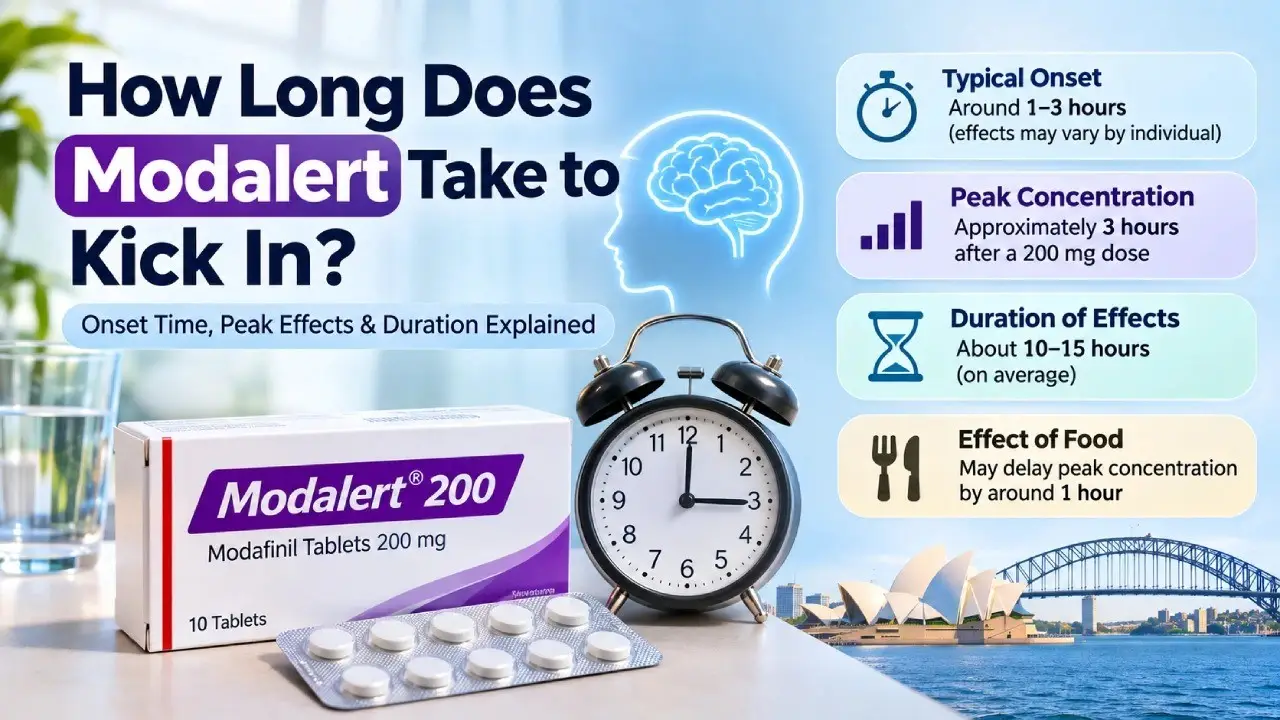

People researching how long Modalert takes to kick in often want to understand how quickly modafinil is absorbed, when it reaches its highest concentration in the bloodstream and how long its effects may last.
Modalert is a brand of modafinil, a prescription wakefulness-promoting medicine used for certain sleep-related conditions. Its absorption rate, pharmacological properties and individual response are important considerations when understanding its clinical use.
The time required to reach peak plasma concentration is not necessarily the same as the time when someone first notices an effect. Several factors, including food intake, individual metabolism, existing medical conditions and interactions with other medicines, may influence the medication’s pharmacokinetic profile.
In this guide, we explore modafinil absorption, peak concentration, onset variability, duration, possible side effects and important safety considerations.
Modafinil is classified as a central nervous system medicine that promotes wakefulness. It is prescribed for certain conditions involving excessive daytime sleepiness.
Its precise mechanism of action is not completely understood. However, research indicates that modafinil influences several neurological pathways associated with wakefulness and the sleep-wake cycle.
Understanding modafinil and its medical uses can help readers learn about its pharmacological properties, clinical applications and important safety considerations.
It is important to understand that modafinil is not a replacement for sufficient sleep. Its use should be based on an appropriate medical assessment rather than everyday tiredness, productivity goals or concentration difficulties.
One of the most frequently researched questions about modafinil concerns its onset time.
Australian product information reports that modafinil reaches peak plasma concentrations approximately three hours after administration of a 200 mg dose.
However, this measurement describes the time required to reach maximum blood concentration, not a guaranteed time for experiencing clinical effects.
There are three important pharmacokinetic concepts to understand.
Absorption refers to the movement of a medicine from its administration site into the bloodstream.
Following oral administration, modafinil is absorbed gradually. Its absorption characteristics influence how its concentration changes over time.
Time to maximum concentration is commonly represented by Tmax.
For a 200 mg modafinil dose, the reported Tmax is approximately three hours.
This provides a useful pharmacokinetic reference when studying the medicine.
Clinical response refers to the changes experienced by a patient following treatment.
The time at which someone notices a clinical response may differ from the time of peak plasma concentration.
Individual differences mean that a single onset time cannot be guaranteed for everyone.
Peak plasma concentration is an important measurement in pharmacology because it describes the highest concentration of a medicine in the bloodstream following administration.
According to Australian medicine information:
These measurements help explain how the medication moves through the body.
However, peak concentration should not be interpreted as the beginning or end of its clinical effects.
For more detailed information, consult the Australian Modafinil GH medicine information.
Food intake can influence the absorption profile of modafinil.
Australian product information indicates that taking modafinil with food may delay the time required to reach peak plasma concentration by approximately one hour.
Importantly, this delay does not necessarily mean that the total amount of medication absorbed is significantly reduced.
This distinction is important when interpreting pharmacokinetic research.
The following factors should be considered:
Patients should follow their prescribing healthcare professional’s instructions rather than changing their medication routine to accelerate absorption.
The response to medication can vary between individuals. Several physiological and clinical factors may influence how a person responds to modafinil.
Individual Metabolism
Metabolism describes how the body processes and eliminates substances.
Differences in metabolic activity can influence medication exposure and the duration of its presence in the bloodstream.
Liver Function
The liver plays an important role in metabolising many medicines.
People with significant liver impairment may process medications differently. This is one reason medical assessment is important before treatment.
Medication Interactions
Some medicines can affect modafinil absorption, metabolism or clinical response.
Examples of medicines requiring professional interaction assessment include:
This is not a complete list. Patients should provide their doctor or pharmacist with information about all prescription medicines, non-prescription products and supplements they use.
Existing Health Conditions
Medical conditions can influence the safety and suitability of modafinil.
Particular attention may be required for people with cardiovascular conditions, high blood pressure, liver problems or a history of psychiatric illness.
For additional educational information, readers can explore our frequently asked questions.
Onset time and duration are two different pharmacological measurements.
Onset time refers to the period between administration and the beginning of a measurable or noticeable effect.
Duration refers to how long an effect continues.
Elimination half-life describes the time required for the concentration of a medicine in the body to decrease by approximately 50%.
These measurements should not be confused.
Modafinil has an effective elimination half-life of approximately 15 hours after repeated administration, although individual pharmacokinetic characteristics can vary.
This does not mean that someone will experience the same level of wakefulness throughout that entire period.
Similarly, the presence of a medicine in the bloodstream does not mean that its clinical effects remain constant throughout that period.
No. Modafinil is not a substitute for adequate sleep.
Sleep is essential for memory consolidation, immune function, emotional regulation, metabolic health and normal cognitive performance.
A medicine that promotes wakefulness does not eliminate the biological need for sleep.
People experiencing persistent daytime sleepiness should receive an appropriate medical assessment to identify the underlying cause.
Possible contributing factors include:
A healthcare professional can help determine whether additional investigations or treatment are necessary.
Like other prescription medicines, modafinil can cause adverse effects.
Reported side effects include:
Some reactions can be serious and require immediate medical attention.
Modafinil has been associated with rare but serious skin reactions.
Warning signs can include:
Seek urgent medical attention if these symptoms occur.
Other serious reported reactions include psychiatric symptoms, chest pain, abnormal heart rhythms and seizures.
Anyone experiencing severe or unexpected symptoms should seek appropriate medical care.
The official Australian Consumer Medicine Information provides additional information about adverse reactions and precautions.
Modafinil is a Schedule 4 prescription medicine in Australia. Its use requires appropriate clinical assessment and medical supervision.
Important safety considerations include:
For official Australian regulatory information, consult the Therapeutic Goods Administration (TGA).
Australian pharmacokinetic information reports that modafinil reaches peak plasma concentrations approximately three hours after a 200 mg dose. Individual clinical responses may vary.
What is the peak concentration time of modafinil?
The reported time to maximum plasma concentration is approximately three hours following a 200 mg dose.
Does food delay modafinil absorption?
Yes. Food may delay peak plasma concentration by approximately one hour. However, overall bioavailability is not significantly affected.
Is peak plasma concentration the same as onset time?
No. Peak plasma concentration represents the highest measured drug concentration in the bloodstream. Clinical onset refers to when an effect becomes noticeable or measurable.
Can individual metabolism affect modafinil response?
Yes. Differences in metabolic activity, liver function, other medicines and individual physiology may influence medication exposure and response.
Does modafinil replace sleep?
No. Modafinil promotes wakefulness in specific clinical situations but does not replace the physiological benefits of adequate sleep.
Is modafinil a prescription medicine in Australia?
Yes. Modafinil is classified as a Schedule 4 prescription medicine in Australia and requires appropriate medical supervision.
Can modafinil cause insomnia?
Yes. Difficulty sleeping is a reported adverse effect. Patients should discuss persistent sleep problems with their healthcare professional.
Where can I find official modafinil safety information?
The Australian Medicine Finder provides official Consumer Medicine Information and product information. Patients can also consult the Therapeutic Goods Administration for medicine safety and regulatory guidance.
Understanding how long Modalert takes to kick in requires distinguishing between absorption, peak plasma concentration and clinical response.
Australian product information reports that modafinil reaches peak plasma concentrations approximately three hours after a 200 mg dose. Food intake may delay this measurement by approximately one hour, while individual physiology and medication interactions can influence the overall response.
Most importantly, modafinil is a prescription medicine and should only be used following an appropriate medical assessment.
For further educational reading, visit our modafinil information guide and health and medication blog.
Readers should consult official medicine information and qualified healthcare professionals for personalised advice.
Medical Disclaimer: This article is provided for general educational purposes only. It does not constitute medical advice, diagnosis or treatment recommendations. Modafinil is a prescription-only medicine. Always consult a qualified healthcare professional before making decisions about medication.
Also Read: Modafinil Online in Australia: Essential Safety Tips Every Buyer Should Know






 Alfred




1 Comment